
Watch the video
Throwing, catching and movement
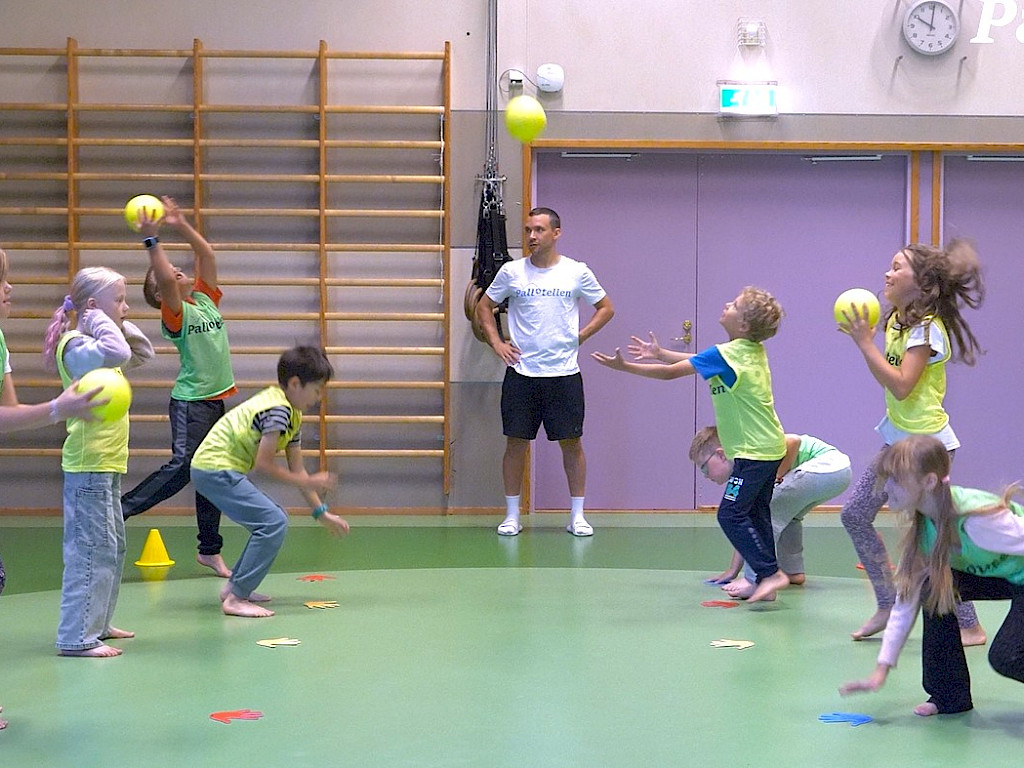
Throwing, catching and movement tasks combine throwing, catching and moving. Throwing, catching and movement tasks are done either with a partner or independently. It is a good idea to choose a basketball or another ball of a similar size that is easy to bounce.
Throw and touch the floor
- The partner and the child stand facing each other at a suitable distance from each other.
- The partner throws the ball to the partner and then touches the floor with their palm.
- The partner catches the ball and throws it back and touches the floor with their palm.
- It is a good idea to place a floor mark, for example, on the floor in front of the child as a reminder and to visualize the throwing location.
Changing places with the partner
- The partner and the child stand facing each other at a suitable distance from each other.
- Imitating a ball with the partner.
- When the adult whistles, the partner and the child quickly change places, after which the imitation continues.
- Another agreed-upon sound signal can also be used instead of the whistle.
Bouncing and spinning
- We stand opposite each other in pairs at a suitable distance from each other, with the sticks behind each other.
- One of the pairs bounces the ball on the floor and spins the stick behind them.
- The other pair catches the ball from the bounce, bounces the ball on the floor and spins the stick behind them.
Retrieve the balls from the pair's hoop to their own hoop
- We place our own hoops at a suitable distance from each other.
- We put the same number of balls in both hoops. The balls can be, for example, tennis balls or tail balls.
- We retrieve one ball at a time from the pair's hoop to our own hoop.
- The pairs move on different sides of the hoops to avoid collisions; the different sides can be marked with different colored sticks to help with visualization, for example.
Catch your throw
- We stand on the same line at the side of the hall, each with their own ball.
- The ball is thrown diagonally upwards and we run to catch our own ball in the air.
- How far can you throw your ball to catch it in the air?
- Give each child time to try different distances.
Throw, catch and jump
- Set up so that everyone has their own space and their own ball.
- Throw the ball in the air, take a box, put the ball on the floor and jump over the ball and back.
- Repeat several times.
Fånga ditt eget kast
- Vi ställer upp oss vid sidan av hallen, var och en med sin egen boll.
- Bollen kastas upp och vi springer för att fånga vår egen boll i luften.
- Hur långt kan vi kasta den för att fånga vår egen boll i luften?
- Vi ger varje barn tid att prova olika avstånd.
This project is sponsored by
-

Suomi liikkeelle -ohjelma
Liikunnalliset vinkit videoiksi pienten lasten liikuttajille -hanketta rahoitetaan hallitusohjelman Suomi liikkeelle -ohjelmasta, jonka tavoitteena on kääntää liikkuminen kasvuun jokaisessa ikäryhmässä.